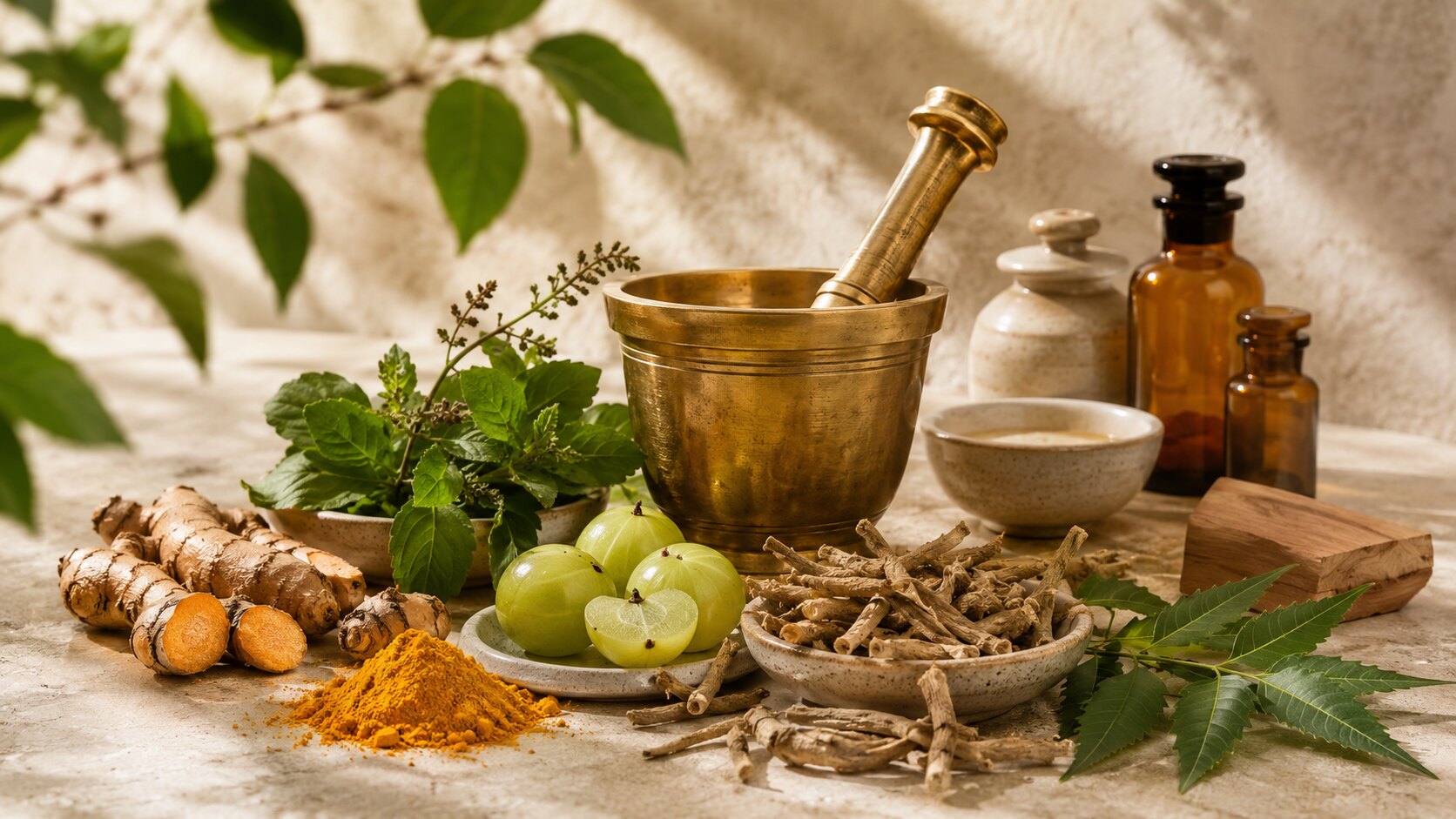
For centuries, Ayurveda has encouraged people to live in harmony with their bodies, their surroundings and the natural rhythms of life. Modern medicine, meanwhile, has transformed healthcare through scientific discovery, accurate diagnosis, effective medicines, surgery and emergency treatment.
Yet somewhere along the way, a debate emerged: Should we trust Ayurveda or modern medicine?
Some people believe that natural remedies and traditional practices are enough to maintain health and overcome illness. Others dismiss Ayurveda as outdated, preferring only treatments that belong to conventional medicine.
But perhaps we are asking the wrong question.
What if the choice is not between Ayurveda and modern medicine? What if the real opportunity lies in understanding what each can offer, recognising its limitations and making informed decisions that put our health first?
At VedaVaya, we believe that the pursuit of well-being should be guided by wisdom, openness and respect for evidence—not by the need to prove one tradition superior to another.
1. Health Begins Long Before Illness
One of Ayurveda's most valuable contributions is its emphasis on the relationship between everyday habits and long-term well-being.
Ayurveda is a traditional Indian system of health that considers diet, physical activity, sleep, daily routines and the relationship between the individual and their environment. Its philosophy encourages people to pay attention to their bodies and adopt practices that support balance and well-being.
The principle behind this approach remains highly relevant today.
Modern scientific research also demonstrates that everyday behaviours can significantly influence our health. According to the World Health Organization (WHO), tobacco use, physical inactivity, unhealthy diets and harmful alcohol consumption are major risk factors for noncommunicable diseases, including cardiovascular disease, type 2 diabetes and some cancers.
This means that our daily choices matter—not because they guarantee freedom from disease, but because they can influence our risk of developing certain conditions.
Eating a balanced diet, staying physically active, sleeping adequately, managing stress and avoiding harmful habits are not merely fashionable wellness trends. They are important components of preventive healthcare.
Ayurveda provides a traditional framework through which many people can approach these habits. Modern science helps us evaluate which specific practices are beneficial, for whom they are appropriate and where the evidence remains uncertain.
The lesson is simple: caring for our health should be a daily practice, not something we think about only when we become ill.
Reference: World Health Organization — Noncommunicable diseases.
2. Prevention and Treatment: Two Sides of Healthcare
Imagine two people.
The first makes time for regular physical activity, eats a balanced diet, maintains a consistent sleep routine and attends appropriate health screenings. These habits may help reduce certain health risks over time.
The second pays little attention to these matters and eventually develops a medical condition requiring professional care.
Their situations are different, and their healthcare needs may be different too.
The first person benefits from prevention. The second may need diagnosis, medication, surgery or another appropriate treatment. In many cases, they may need a combination of lifestyle changes and medical care.
This distinction helps us understand the relationship between Ayurveda and modern medicine, but it is important not to oversimplify it.
Ayurveda has traditionally placed considerable emphasis on maintaining health and preventing imbalance, while also including remedies and treatments for illness. Modern medicine, contrary to a common misconception, is not limited to treating disease after it develops. It also encompasses prevention, vaccination, screening, risk reduction and long-term health management.
Furthermore, illness is not always the consequence of poor lifestyle choices. Genetic conditions, infections, congenital disorders, environmental exposures and many other factors can affect health, even when a person lives conscientiously.
A person who develops diabetes, for example, should not automatically be blamed for their condition. Nor should someone with a healthy lifestyle assume that they are immune to serious illness.
The most sensible approach is to recognise the value of prevention without underestimating the importance of treatment.
Prevention helps us protect the health we have. Treatment helps us respond when health problems arise. We need both.
3. Ayurveda and Modern Medicine Can Coexist
One of the most unfortunate aspects of the Ayurveda-versus-modern-medicine debate is the belief that embracing one requires rejecting the other.
Some people who strongly favour traditional medicine may discourage patients from seeking conventional treatment. Others may dismiss traditional practices without considering whether particular elements could safely complement a person's healthcare routine.
Neither position is a sound basis for making healthcare decisions.
The WHO's Global Traditional Medicine Strategy 2025–2034 recognises the importance of strengthening scientific evidence, ensuring safety and quality, and integrating traditional, complementary and integrative medicine into healthcare systems where appropriate.
The emphasis is not on accepting every traditional claim or rejecting every conventional one. It is on determining what is safe, effective and appropriate.
Consider a few examples:
Daily routines: A consistent sleep schedule, a balanced diet and regular physical activity can complement medical care and support general health.
Yoga and relaxation: Suitable movement, breathing exercises and relaxation practices may be useful additions to a person's overall well-being routine, depending on their needs and circumstances.
Chronic conditions: Someone receiving treatment for hypertension, diabetes or another long-term condition may also benefit from appropriate lifestyle improvements. These should complement, not automatically replace, prescribed treatment.
Acute illness and emergencies: Serious infections, severe allergic reactions, heart attacks, strokes and major injuries require timely medical assessment and appropriate treatment. Traditional practices must never delay urgent care.
This is the essence of complementary care: using appropriate practices alongside conventional healthcare when doing so is safe and beneficial.
It does not mean combining treatments indiscriminately. It means making thoughtful choices in consultation with qualified healthcare professionals.
Reference: WHO — Global Traditional Medicine Strategy 2025–2034.
4. Natural Does Not Always Mean Safe—and Conventional Does Not Mean Perfect
A balanced approach also requires us to challenge assumptions on both sides.
Natural ingredients can contain biologically active compounds. Some may have useful therapeutic properties, and scientific investigation of traditional medicinal plants has contributed to our understanding of potential treatments.
However, the presence of an active compound does not automatically prove that a particular remedy is effective for a particular disease.
Its effects may depend on the ingredient, dose, preparation, quality, duration of use and the person taking it. A promising laboratory result is not the same as reliable evidence of benefit in humans.
The US National Center for Complementary and Integrative Health (NCCIH) notes that some studies of Ayurvedic preparations have suggested potential benefits for particular conditions, including osteoarthritis and type 2 diabetes. However, many studies have been small or poorly designed, and the evidence remains limited for numerous other uses.
Safety matters just as much.
Some Ayurvedic preparations have been found to contain potentially harmful amounts of lead, mercury or arsenic. Certain herbal products can also interact with prescription medicines. This does not mean that every Ayurvedic product is unsafe; it means that quality, composition, testing and professional guidance matter.
Likewise, conventional medicines can have side effects and limitations. Their use should be based on an appropriate assessment of benefits, risks and individual circumstances.
Neither tradition nor technology deserves unquestioning loyalty.
Both deserve careful evaluation.
At VedaVaya, we believe that respect for traditional knowledge and respect for modern science should reinforce each other. The goal is not to make exaggerated promises, but to understand ingredients, recognise limitations and make responsible choices.
References: NCCIH — Ayurvedic Medicine: In Depth and US FDA — Warning about heavy metals in certain unapproved Ayurvedic products.
5. The Forgotten Ingredient in Wellness: Consistency
There is another lesson worth taking from Ayurveda: the importance of regularity.
Many people begin a wellness routine with enthusiasm. They start drinking a particular herbal infusion, practise yoga, improve their diet or establish a bedtime routine. For a few days, everything goes well.
Then work becomes busy. Old habits return. The routine gradually disappears.
A few weeks later, they may conclude that the practice did not work.
But meaningful improvements in health-related habits often depend on what we do repeatedly, not what we do occasionally.
One healthy meal does not establish a balanced diet. A single walk does not create an active lifestyle. One good night's sleep does not compensate for months of inadequate rest.
Consistency gives beneficial habits the opportunity to make a difference over time.
This is where the traditional emphasis on daily routines offers a particularly valuable perspective. Instead of treating wellness as an occasional project, we can make it part of the way we live.
That does not mean every Ayurvedic ritual is scientifically proven, or that repeating a practice guarantees better health. Consistency cannot make an ineffective remedy effective, eliminate an unsafe ingredient or replace a treatment that is medically necessary.
The practice itself must be appropriate. Once that is established, regularity becomes important.
Start small. Choose wisely. Continue consistently.
You do not need to transform your entire life overnight. Begin with habits that are realistic and suitable for you.
Establish a regular sleep and waking schedule.
Make balanced, varied meals a normal part of your routine.
Incorporate physical activity that matches your abilities.
Set aside time for relaxation and reflection.
Adopt personal-care rituals that are appropriate for your needs.
Seek preventive health checks and professional advice when indicated.
Choose practices you can sustain rather than routines that look impressive but are difficult to maintain.
Over time, these small decisions can become part of a more considered way of living.
The power is not in doing everything. It is in consistently doing the right things.
6. Do Not Let Belief Become a Barrier to Healing
There is a difference between appreciating a traditional healing system and believing that it must be used for every health problem.
The same distinction applies to modern medicine.
A person may find meaning, comfort and structure in Ayurvedic practices. Another may place greater confidence in conventional medical approaches. Both deserve respect. But personal beliefs should not prevent either person from receiving appropriate healthcare.
If an Ayurvedic practitioner advises someone to stop prescribed medication without appropriate medical supervision, that advice deserves careful scrutiny. Similarly, dismissing a person's interest in safe traditional practices without considering the evidence may undermine a constructive conversation about their health.
The better approach is communication.
Tell your doctor about herbal products, supplements and traditional remedies you use. Ask whether they could interact with your medicines. Consult an appropriately qualified practitioner when considering a treatment, and seek reliable information about its benefits and risks.
Never stop, delay or alter prescribed treatment simply because a traditional remedy is believed to be more natural or more holistic.
And never assume that a treatment is unsuitable merely because it originated outside modern conventional medicine. Evaluate the actual evidence and the individual circumstances.
When different approaches can be used safely together, collaboration is preferable to conflict.
When evidence shows that one treatment is more appropriate, that evidence should guide the decision.
Our responsibility is not to defend a system at all costs. It is to protect human health.
7. A More Thoughtful Understanding of Ayurveda
Perhaps the greatest value of Ayurveda today is not found in the promise of a miraculous cure, but in the reminder that health deserves attention every day.
It encourages us to become more conscious of our routines, to pay attention to our bodies and to recognise that well-being is influenced by many interconnected aspects of life.
Modern medicine adds essential capabilities: rigorous investigation, diagnostic tools, emergency interventions, proven therapies and the ability to monitor and manage many complex conditions.
Neither perspective needs to erase the other.
At the same time, we should distinguish between traditional philosophy, practical lifestyle habits and specific medicinal claims. Each requires its own assessment. A balanced diet or a suitable exercise routine may have a strong evidence base, while a particular herbal formulation promoted for curing a serious disease may not.
The responsible path is to preserve what is valuable, investigate what is uncertain and avoid claims that go beyond the evidence.
That is how traditional wisdom can remain relevant in a world shaped by modern science.
The VedaVaya Philosophy: Wisdom in Practice, Science in Perspective
At VedaVaya, we see wellness as a journey rather than a quick fix.
We believe that caring for ourselves should not begin only when something goes wrong. It should be reflected in the small choices we make each day—in the habits we build, the products we select, the information we trust and the care we give our bodies.
We also believe that traditional knowledge should be approached with respect, while health-related claims should be approached with honesty.
Ayurveda and modern medicine need not be opposing forces. They can represent different contributions to a shared goal: helping people make informed decisions about their health and well-being.
There will be times when a daily wellness practice is appropriate. There will be times when professional medical treatment is essential. There will also be times when both can play a role, provided that their combined use is safe and supported by evidence.
The wisdom lies in knowing the difference.
And whatever healthy habits we choose, their value lies not in how enthusiastically we begin, but in how thoughtfully and consistently we practise them.
Because a healthier life is not built through a battle between old and new. It is built through informed choices, responsible care and consistency over time.
VedaVaya — Timeless wisdom. Engineered precision.
References and further reading
World Health Organization (WHO). Noncommunicable diseases. Overview of major risk factors, prevention and treatment.
https://www.who.int/news-room/fact-sheets/detail/noncommunicable-diseasesWorld Health Organization (WHO). Global Traditional Medicine Strategy 2025–2034. Evidence, safety, quality and appropriate integration of traditional medicine.
https://www.who.int/publications/i/item/9789240113176National Center for Complementary and Integrative Health (NCCIH). Ayurvedic Medicine: In Depth. Evidence concerning potential benefits, limitations and safety.
https://www.nccih.nih.gov/health/ayurvedic-medicine-in-depthNational Center for Complementary and Integrative Health (NCCIH). Are You Considering a Complementary Health Approach? Guidance on safety, interactions and communication with healthcare providers.
https://www.nccih.nih.gov/health/are-you-considering-a-complementary-health-approachUS Food and Drug Administration (FDA). FDA warns about heavy metal poisoning associated with certain unapproved Ayurvedic drug products.
https://www.fda.gov/drugs/fraudulent-products/fda-warns-about-heavy-metal-poisoning-associated-certain-unapproved-ayurvedic-drug-products
Health note: This article is for general educational purposes only. It is not a substitute for personalised medical advice, diagnosis or treatment. Consult a qualified healthcare professional before starting herbal medicines or supplements, particularly if you take prescription medication, are pregnant or breastfeeding, or have an existing medical condition.